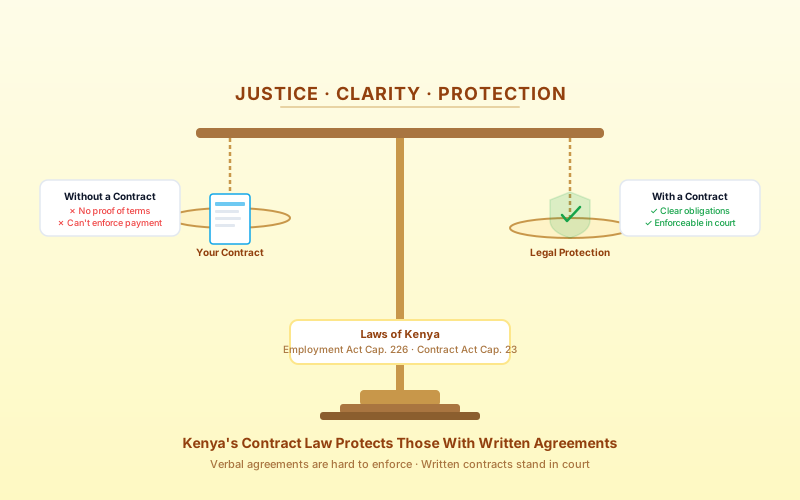
In Kenya, personal and business lending between individuals is extremely common — from friends lending each other money to start a business, to SMEs borrowing from private investors. Yet most of these loans happen with nothing in writing. When the borrower doesn't pay, the lender has almost no legal recourse.
A written loan agreement changes everything. It creates a legally enforceable obligation and gives both parties clarity from day one.
Is a Verbal Loan Agreement Enforceable in Kenya?
Technically, yes — verbal contracts can be enforceable in Kenya under the Law of Contract Act (Cap. 23). But proving a verbal loan agreement in court is extremely difficult. You need evidence of the amount, the terms, and the agreement — none of which exists when there's no paper trail.
The M-Pesa problem: Many Kenyans lend money via M-Pesa and assume the transfer record is proof enough. It isn't. An M-Pesa statement shows money moved between two numbers — it doesn't prove it was a loan, the agreed repayment terms, or the interest rate. A court will need much more than that.
What the Kenya Money Lenders Act Says
If you lend money commercially (as a business rather than a one-time personal loan), the Money Lenders Act (Cap. 528) may apply. Under this Act, unlicensed money lending businesses are illegal, and any loan agreement entered into by an unlicensed lender may be unenforceable.
For private, non-commercial loans between individuals or businesses — the kind this article covers — the Act generally does not apply. However, there are interest rate considerations to be aware of (see below).
What Your Loan Agreement Must Include
1. The Principal Amount
State the exact amount being lent in Kenya Shillings. Write it in both numerals and words (e.g., "KES 100,000 (Kenya Shillings One Hundred Thousand only)") to prevent disputes about the figure.
2. Interest Rate — or Confirmation That It's Interest-Free
If you're charging interest, state the rate clearly as a percentage per month or per year. If the loan is interest-free (common between family members or close associates), state that explicitly — otherwise the borrower may later claim they thought no interest was due even if you intended some.
Kenya's usury context: Unlike some jurisdictions, Kenya does not have a statutory maximum interest rate for private loans between individuals. The interest rate you agree on is the rate that applies — but courts can declare an interest rate unconscionable if it is grossly excessive.
3. Repayment Schedule
Be specific. "Pay me back when you can" is not a repayment schedule. Instead: "KES 10,000 on the 5th of each month starting 5 August 2026, until the full principal and interest are repaid." This creates a clear default date if a payment is missed.
4. Payment Method
Specify exactly how repayment must be made — M-Pesa number, bank account, or cash with a receipt. This prevents the borrower from claiming they attempted to pay but couldn't reach you.
5. Late Payment Penalty
Define what happens if a payment is late. A standard approach is a percentage penalty per month on the overdue amount (e.g., 5% per month on any overdue balance). This creates a financial incentive to pay on time and compensates the lender for the cost of chasing payment.
6. Default and Acceleration
Include an acceleration clause: if the borrower misses X consecutive payments (typically 2–3), the entire outstanding balance becomes immediately due. Without this, you can only sue for each missed payment as it falls due — a separate case for every month.
7. Collateral or Security (if any)
If the loan is secured against an asset (a vehicle, a title deed, equipment), describe it precisely: make, model, registration number for vehicles; LR number and county for land. Specify what the lender's rights are if the borrower defaults — can you repossess the asset? Sell it? You need to state this clearly.
How to Enforce a Loan Agreement in Kenya
If the borrower defaults and you have a written agreement, you can:
- File a demand letter through a lawyer (often enough to prompt payment)
- File a claim in the Small Claims Court for amounts up to KES 1,000,000 — fast and affordable
- File a civil suit in the Magistrates Court (up to KES 20 million) or the High Court
- Apply for attachment of property or garnishment of bank accounts once judgment is obtained
Without a written agreement, you are limited to whatever evidence you can gather — which is usually insufficient for a court to grant judgment.
Generate your Loan Agreement in 2 minutes
Kenya-compliant · Professional PDF · KES 499 · First 2 downloads free
Get Your Loan Agreement →