You've built something valuable — a product, a process, a client list, a business model. Before you share those details with a potential partner, investor, contractor, or employee, you need a Non-Disclosure Agreement (NDA). This is true whether you're a startup founder in Westlands or a consultant in Mombasa.
An NDA is a legally binding contract that prevents the other party from sharing or misusing confidential information you give them. Here's when you need one and what it must say.
When Do You Need an NDA in Kenya?
- Investor meetings: Before pitching your business model, financial projections, or proprietary technology
- Hiring contractors or freelancers: Anyone who will access your systems, client data, or internal processes
- Business partnerships: Before discussing a merger, joint venture, or distribution agreement
- Employment: For employees in sensitive roles (sales, tech, management) who handle client lists or trade secrets
- Software development: Before sharing source code, APIs, or technical specifications with a developer
Rule of thumb: If the information would hurt your business if a competitor got hold of it, get an NDA before sharing it with anyone.
Key Clauses in a Valid Kenyan NDA
1. Definition of Confidential Information
This is the most important clause. Define clearly what is — and isn't — covered. A broad definition is fine: "all business, technical, financial, and commercial information shared by the Disclosing Party, whether in writing, verbally, or in any other form." You can also specifically list: client lists, source code, pricing models, business plans, etc.
2. Obligations of the Receiving Party
The receiving party must agree to:
- Hold the information in strict confidence
- Use it only for the stated purpose (e.g., evaluating a partnership)
- Not disclose it to any third party without written consent
- Use the same level of care as they use for their own confidential information (minimum: reasonable care)
3. Exclusions from Confidentiality
Not everything can be kept secret forever. A well-drafted NDA excludes information that:
- Is or becomes publicly available through no fault of the receiving party
- Was already known to the receiving party before disclosure
- Is independently developed by the receiving party
- Is required to be disclosed by law or court order
4. Term of the Agreement
State how long the NDA lasts. For business partnerships: 2–3 years is standard. For employees with access to trade secrets: 3–5 years. For highly sensitive tech: indefinitely, or until the information enters the public domain.
5. Return or Destruction of Materials
On request, the receiving party must return or destroy all confidential materials — including copies, notes, and digital files — and confirm in writing that this has been done.
6. Remedies for Breach
Include a clause acknowledging that monetary damages may be insufficient for a breach (because your business secrets can't be "unpublished"). This allows the disclosing party to seek an injunction in court to stop the breach immediately, without waiting for a full trial.
One-Way vs Two-Way NDAs
| Type | When to Use | Example |
|---|---|---|
| One-Way (Unilateral) | Only one party is sharing confidential info | You sharing your business idea with a contractor |
| Two-Way (Mutual) | Both parties are sharing confidential info | Two businesses exploring a partnership or merger |
Governing Law and Enforcement in Kenya
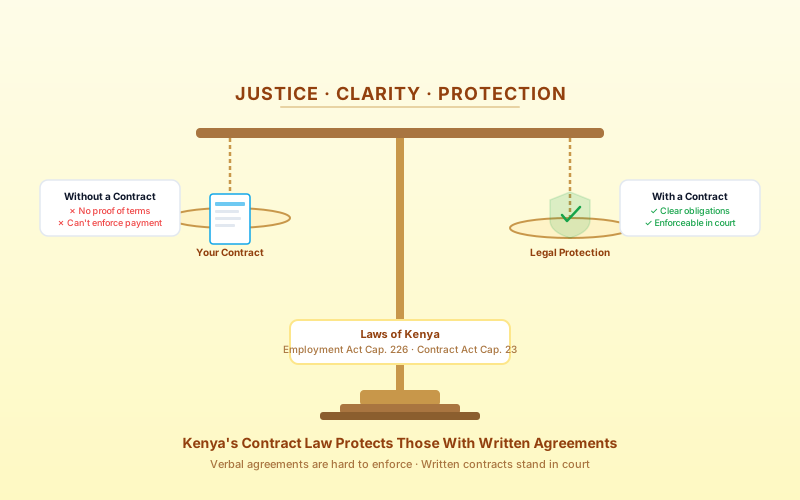
NDAs in Kenya are enforceable under the Law of Contract Act Cap. 23. Courts have upheld NDAs where the scope of confidential information was clearly defined and the obligations were reasonable. Vague, overreaching NDAs (e.g., trying to cover all information forever) are harder to enforce.
For enforcement, the aggrieved party can apply for an injunction in the High Court — particularly urgent if the breach involves a competitor accessing trade secrets.
Generate your Non-Disclosure Agreement in 2 minutes
Kenya-compliant · Professional PDF · KES 399 · First 2 downloads free
Get Your Non-Disclosure Agreement →