You delivered the work. You sent the invoice. Silence. A week passes, then a month. Your client is either ignoring you, making excuses, or has simply disappeared. This is one of the most common and painful experiences for Kenyan freelancers, consultants, and small business owners.
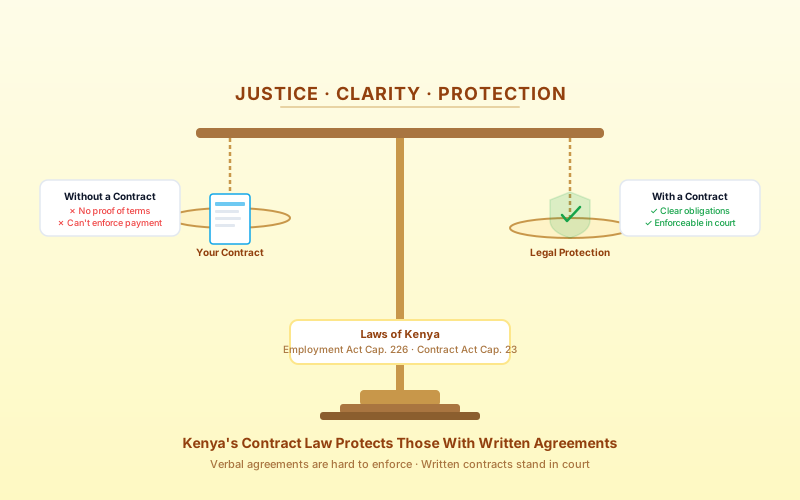
The good news: Kenya's legal system gives you real options. The bad news: how many options you have depends heavily on whether you had a written contract in the first place.
Step 1: Send a Formal Written Demand
Before anything else, send a formal written demand via email (with read receipt) and, if possible, by physical letter. This demand should:
- State the exact amount owed and the invoice date(s)
- Reference the contract or agreement the work was done under
- Give a clear deadline for payment (7–14 days is standard)
- State what action you will take if payment is not received by the deadline
Many clients pay at this stage — especially when they realise you are serious and have documentation. The tone should be firm but professional. Do not threaten things you are not prepared to follow through on.
Why this matters legally: Courts in Kenya look for evidence that you tried to resolve the matter before filing. A formal demand letter starts the paper trail and demonstrates good faith on your part.
Step 2: Check What Your Contract Says
If you have a service agreement or freelance agreement, read the dispute resolution clause. Many contracts require parties to attempt mediation before going to court. Following this clause protects your claim — ignoring it can give the other side a procedural argument against you.
If you had no written contract, your options are not gone — but they are harder. You'll need to rely on email correspondence, WhatsApp messages, bank records, delivery receipts, and any other evidence of the agreement and the work delivered.
Lesson for the future: This is precisely why written contracts matter. Without one, you are spending money and time proving in court what a one-page agreement could have made undeniable.
Step 3: The Small Claims Court (For Amounts Up to KES 1,000,000)
Kenya's Small Claims Court, established under the Small Claims Court Act No. 2 of 2016, is designed exactly for situations like this. It handles claims up to KES 1,000,000 and is significantly faster and cheaper than the ordinary courts.
- Filing fee: approximately KES 500–2,000 depending on the claim amount
- No lawyer required (though you can use one)
- Cases are typically resolved in weeks rather than years
- Hearings are informal — you present your evidence and the adjudicator decides
- Currently operating in Nairobi, Mombasa, Kisumu, Nakuru and expanding
For freelancers and small business owners, the Small Claims Court is the single most useful legal tool available. It was built for exactly this situation.
Step 4: Magistrates Court (Up to KES 20 Million)
For amounts between KES 1,000,000 and KES 20,000,000, the Magistrates Court handles civil debt claims. You will typically need a lawyer, and the process takes longer — but it remains accessible and far cheaper than the High Court.
You file a plaint, the defendant is served, they enter a defence (or don't, in which case you apply for default judgment), and the matter proceeds to hearing. A straightforward debt claim with good documentation can be resolved in 6–12 months.
Step 5: Statutory Demand and Winding Up (For Companies)
If the client is a registered company, you have an additional nuclear option: a statutory demand under the Insolvency Act 2015. If a company owes you more than KES 100,000 and cannot pay, you can issue a statutory demand. If it remains unpaid after 21 days, you can file a winding-up petition.
Most companies pay at the statutory demand stage — the prospect of being wound up is a powerful incentive. However, this is a serious step that should be taken with legal advice.
What Damages Can You Claim?
| Type of Claim | What You Can Recover |
|---|---|
| Invoice amount | The full unpaid amount |
| Late payment interest | If specified in your contract, or court award |
| Legal costs | Courts can order the losing party to pay costs |
| Lost profits | If you can prove consequential loss (harder) |
Protect Yourself Before the Next Invoice
The best way to deal with non-payment is to make it structurally unlikely from the start:
- Get a deposit (30–50%) before starting any work
- Use a written service agreement or freelance contract that specifies payment terms and late fees
- Include a clause allowing you to stop work after X days of non-payment
- Invoice promptly and follow up on the due date, not weeks after
- Include a late payment fee clause — even 2% per month focuses the client's attention
Get a contract that protects your payment from day one
Service Agreement, Freelance Agreement, or any other — from KES 399 · Instant PDF
Create Your Contract →